Stages of behavior change
Behaviour change is not a straight line, it's a cycle.
Habits form through repetition. Our brains are programmed to conserve energy wherever possible, so they automate actions that have been repeated again and again. Unhealthy behaviour is therefore often the result of unhealthy choices that, over time, have become unconscious, unhealthy habits.
Fortunately, it is possible to reshape these unhealthy habits through behaviour change, gradually developing healthier choices and, over time, healthy habits. This process involves the following steps:
- Awareness: Recognising and acknowledging unhealthy habits and their triggers.
- Preparation: Setting clear, achievable goals for change.
- Action: Implementing new, healthy habits by taking small, manageable steps.
- Maintenance: Staying consistent and patient; behaviour change takes time and effort.
This process is captured beautifully in the theoretical model of behaviour change.
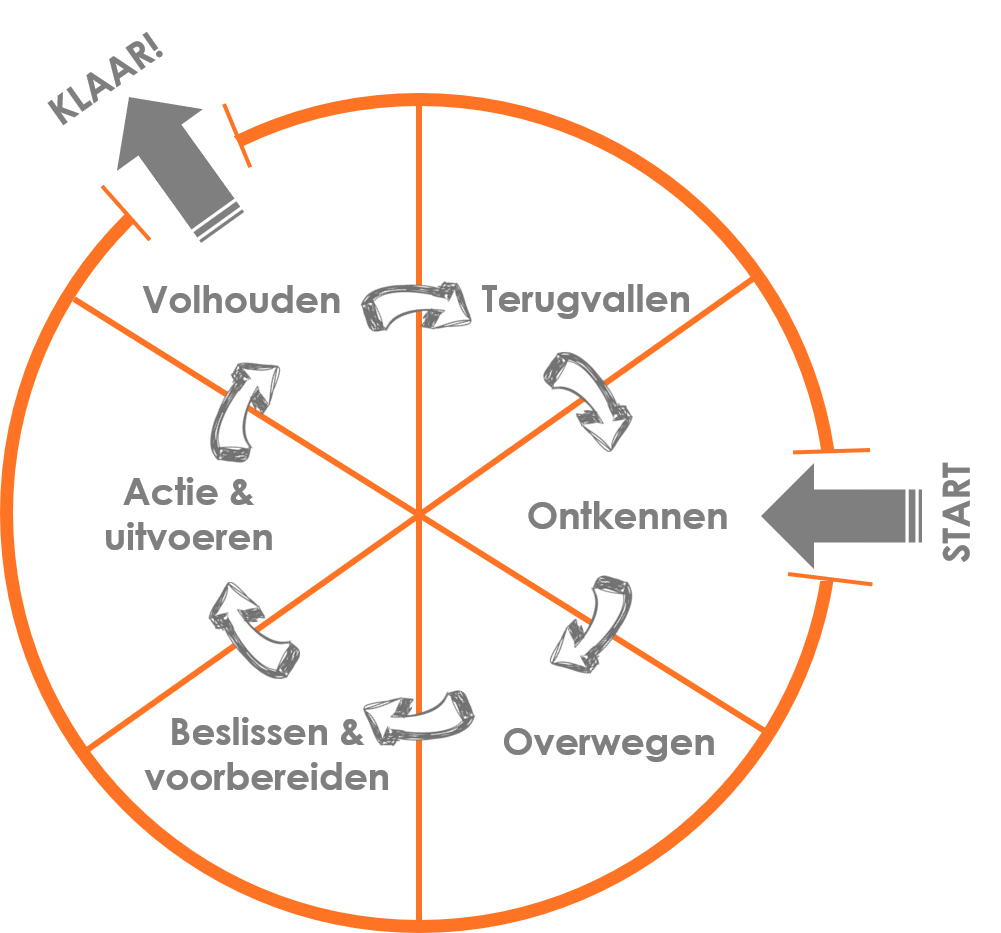
This model describes the cycle we go through when we want to build a new habit or break an old one. It's important to understand that we are all at a different stage, and we can only move forward to the next one — you can't skip steps.
- Denial: We all start in the denial stage. At this point we're not aware of the need to change our behaviour, so we keep repeating the unhealthy action until it becomes a habit.
- Contemplation: Eventually, the realisation sets in that a certain behaviour has drawbacks, and we start to think about changing it.
- Preparation: After this contemplation phase, we reach the point where we decide to change and begin to prepare.
- Action: In this zone of truth, we take action to break unhealthy habits by making healthier choices. The longer we can stay in this zone, the faster we can change our behaviour.
- Maintenance: You might succeed in sustaining the change from the very first attempt, but usually that's not the case. Try to hold on as long as you can and don't be too hard on yourself if you can't maintain it. That's completely normal!
- Relapse: Building or breaking a habit takes energy, and we won't always be able to summon that energy. That's okay — it's simply how our brains work. What matters is that you keep going and restart the cycle as quickly as possible.
The right mindset for behaviour change
Once we're familiar with the different stages of behaviour change, the right mindset becomes clear: keep the wheel of change turning! The most important thing is not to give up. Building a new habit takes time, and the process will inevitably involve trial and error.
The strength of this model lies precisely in the recognition that relapse is an important part of behaviour change. By relapsing, we learn how to do better next time. What matters is getting the wheel turning again as quickly as possible after a setback.
The secret to building a new habit
Building a new habit is both simple and challenging. A habit is essentially an automatic action that has formed through repetition. If we do something often enough, our brains will automate it. While the principle is straightforward — repeat until it becomes a habit — staying consistent through those repetitions is what makes the process hard.
Looking at the behaviour change model, we can see that building a new habit comes down to two key principles:
- Spend time in the golden zones: action and maintenance. Every time you carry out the desired behaviour or think about it, you take one step closer to developing a new habit.
- Avoid the red zones: relapse and denial. If you slip back, it's crucial to restart the process as quickly as possible. Staying stuck in these phases only reinforces the old, unhealthy habit.
In other words, the goal is simply to return to the contemplation, preparation, and action stages as quickly as possible — and to stay there as long as possible.
A practical example: quitting smoking!
Let's look at what the behaviour change process looks like for someone who wants to quit smoking.
- Denial: Imagine you've been smoking for years and it feels like a normal part of your life. You tell yourself smoking helps you unwind after a long day, and you don't really stop to think about what it's doing to your body.
- Awareness: Then you get a Synapse analysis that shows you what smoking is actually doing to your body. Suddenly you see the impact: you get out of breath more easily, you have a persistent cough, and you start to realise these aren't just minor complaints. You become aware of the damage smoking causes, and the idea of quitting begins to grow.
- Preparation: You decide it's time to stop. You set a date and start preparing. You look into options like nicotine patches, talk to friends and family for support, and think of ways to avoid situations that normally trigger you to smoke.
- Action: The big day arrives and you stop smoking. It's hard, but you use nicotine patches to manage the worst withdrawal symptoms. You avoid the places where you used to light up, and you even start exercising to better manage your stress.
- Maintenance: The first few weeks go surprisingly well, but then a difficult moment arrives. Maybe you've had a stressful day and you feel the urge to smoke again. But you remind yourself why you wanted to quit. You keep going, keep exercising, and notice that it helps reduce the urge.
- Relapse: Then, after a particularly tough week, you give in and light a cigarette. It feels like a setback, but instead of judging yourself, you decide not to give up. You think about what went wrong and make a new plan: maybe you'll add meditation to your routine to better manage stress. You start again, with fresh energy.
- The secret: keep the wheel of change turning! The path isn't always easy. You may have a few more relapses, moments when it just doesn't work out. But you keep trying, time after time. Each time, you learn something new about yourself and what you need to succeed. And eventually, by persisting and not giving up, not smoking becomes a habit. You reach your goal — and that feels great.
Extra tips for behaviour change
- No pain, no gain: Behaviour change is often hard and can feel uncomfortable. Accept this challenge and see it as an opportunity to grow. It won't always be easy, but persistence will pay off in the end.
- Be honest: It's crucial to be honest with yourself. Recognise the moments when you're sabotaging yourself or making excuses. Real change begins with self-awareness and letting go of a false self-image.
- Start small, but with sharp focus: Begin with small, achievable goals and work step by step toward your end goal. Focus on progress, not just the final result, and keep your eye on your goal.
Conclusion
Behaviour change is a journey that requires patience, self-awareness, and perseverance. The process unfolds in stages and cycles, from awareness to maintenance. Each phase is essential, and setbacks are part of it — but they give you the chance to learn and come back stronger. By being honest with yourself, taking small steps, and not giving up, you can develop lasting healthy habits and break unhealthy ones. Start today and keep the wheel of change moving — your health and wellbeing will ultimately benefit.
Read next
Stress diary template
A stress diary is a powerful tool for gaining insight into your stress triggers and how you respond to them. By…
Alcohol diary
Keeping an alcohol diary is an effective way to gain insight into your drinking habits and the triggers that lead you…
Behavior change action plan
Changing your behaviour and building new habits can be challenging, but with a structured step-by-step plan it becomes…
Emotional eating
Nutrition plays a crucial role in our physical wellbeing, but it also has a profound influence on our emotions and…